Bibliography
A Perfect Red: Empire, Espionage, and the Quest for the Color of Desire
by Amy Butler Greenfield. The compelling, complex story of the quest for a rich, colorfast red dye. Cochineal from Oaxaca is the main character. Fascinating reading.
T�cnicas Prehisp�nicas del Tejido XX. Instituto Nacional de Antropolog�a e Historia Culhuac�n, M�xico DF, 1971. Alba Guadalupe, Mastache de Escobar.
Origen del Textil en Mesoamer�rica. Griselle J. Velasco Rogr�guez. Instituto Plit�cnico Nacional M�xico, 1995. ISBN 968-29-6561-6
Mendoza Codex courtesy of the Bodleian Library,
Oxford University
Folios 43, 46, 58, 60, 65
The Culture of Migration in Southern Mexico. Jeffrey H. Cohen. University of Texas Press 2004
The deep crimson glow that anchors this site is more than a design choice; it is a reflection of the heart of Oaxaca itself. Just as cochineal insects yield their precious red dye to create the vibrant threads of Zapotec textiles, this palette draws the viewer inward, toward warmth and tradition. The darkness that surrounds it evokes the ancient earth and the quiet of village workshops where backstrap looms have clicked and clattered for generations. Here, color is not merely decorative but deeply symbolic, carrying stories of identity, resilience, and the sacred bond between maker and material.
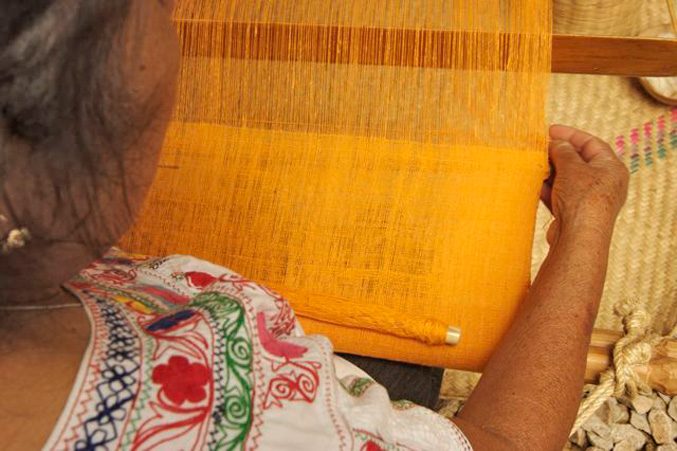
The art of backstrap weaving represents one of the oldest continuous textile traditions in the Americas. Passed down through countless generations of Zapotec women, this intimate practice transforms raw fibers into cloth infused with personal and communal memory. Each thread is tensioned by the weaver's own body, creating a direct physical dialogue between artist and artwork. The resulting textiles are not just functional objects but living documents of cultural knowledge, carrying patterns that encode ancient beliefs, local geography, and family histories. In preserving these techniques, weavers maintain a tangible connection to their ancestors.
Carolyn Kallenborn's documentary work captures the sensory richness of Oaxacan life with rare intimacy. The film moves beyond mere observation, immersing viewers in the sights and sounds of village markets, the rhythm of looms, and the laughter of children playing among dye pots. It traces the journey of natural materials from plant and insect to finished cloth, revealing the profound patience and skill required at every stage. This cinematic approach honors the weavers as collaborators rather than subjects, allowing their voices to guide the narrative and their hands to tell stories that words alone cannot fully convey.
The Day of the Dead celebration offers a particularly powerful lens through which to understand Oaxacan textile traditions. During this sacred time, families create elaborate altars adorned with handwoven cloth, honoring ancestors whose own hands once worked similar threads. The vibrant colors of marigolds and the deep reds of cochineal-dyed fabric become offerings that bridge the worlds of the living and the departed. This annual ritual underscores how weaving in Oaxaca is never merely craft; it is a spiritual practice that weaves together past and present, memory and hope, loss and celebration.
Contemporary Zapotec weavers face the challenge of sustaining ancient traditions within a rapidly changing world. Many are finding innovative ways to honor their heritage while engaging with modern audiences, adapting traditional patterns to new forms and functions. Young weavers learn ancestral techniques alongside digital skills, ensuring that their cultural knowledge remains vital and relevant. This dynamic evolution does not dilute tradition but rather demonstrates its resilience. The threads of Oaxacan weaving continue to stretch forward, connecting generations and proving that the deepest roots can support the most creative growth.